«Producir y nutrir,
producir y no poseer,
obrar y no retener,
acrecentar y no regir,
son el misterio de la vida.»
Degree final work about ISO/IEC 29110
I want a lot to write more in this blog. There are matters I didn’t talk enough about SuperSEC or GUADEC conferences, some announce for 2019 and some some activities in Wikipedia (specially in the Wikiproyecto-Almería and my firsts step in the amazing world of SPARQL), less important but I really enjoy.
But now I want to keep record of significant advances in the university degree I’m finishing these months. I decided to finish a pending course with special interest in the required degree final work, to work in things I’ve been interested since 2003 but never had the oportunity to focus in deep enough to study, learn and write some useful, I hope, tools. And it’s being fun :-)
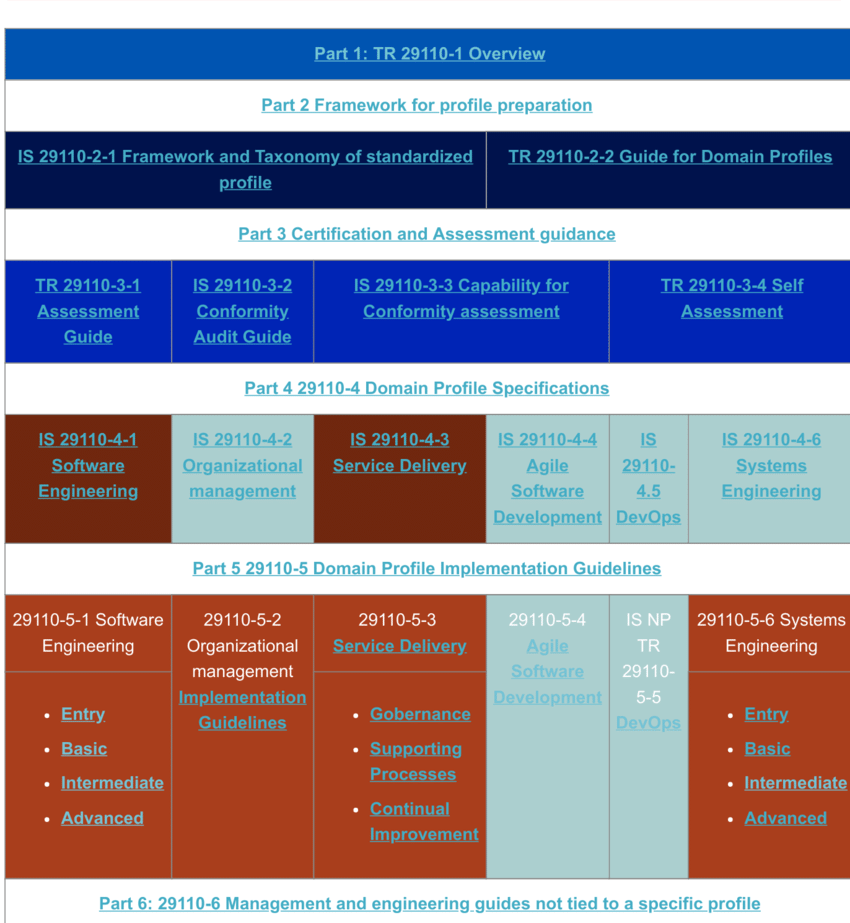
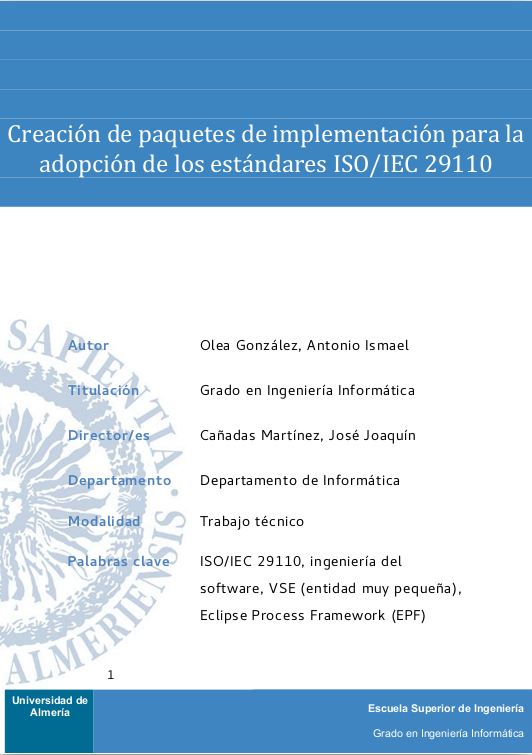
So now I can say the project blueprint has been approved by the university. It’s named «Creation of artifacts for adoption of ISO/IEC 29110 standards» (document in Spanish, sorry) and the goals are to produce a set of opensource artifacts for the adoption of the 29110 family of standards focused on a light software engineering methodology suitable to be adopted by very small entities (VSEs). At the moment my main target is to work in the «Part 5-4: Agile software development guidelines», currently on development by WG24, using the EPF Composer tool.
As a working tool I’m making a (half backed and maybe temporal) website to keep record of related materials at http://29110.olea.org.
Hope to announce related news in the next weeks.
Running EPF Composer in Fedora Linux, v3
Well, finally I succeed with native instalation of the EPF (Eclipse Process Framework) Composer in my Linux system thanks to Bruce MacIsaac and the development team help. I’m happy. This is not trivial since EPFC is a 32 bits application running in a modern 64 bits Linux system.
My working configuration:
- Fedora F28, x86_64
- java-1.8.0-oracle-1.8.0.181, 32 bits, from the non-free Russian Fedora repository:
- java-1.8.0-oracle-1.8.0.181-3.fc28.i586.rpm
- java-1.8.0-oracle-headless-1.8.0.181-3.fc28.i586.rpm
- EPF Composer Linux/GTK 1.5.2
- GTK+ v.2 integration dependencies (from main Fedora repository):
- adwaita-gtk2-theme-3.28-1.fc28.i686.rpm
- libcanberra-gtk2-0.30-16.fc28.i686.rpm
- xulrunner 32 bits xulrunner-10.0.2.en-US.linux-i686.tar.bz2
- libXt-1.1.5-7.fc28.i686.rpm (from main Fedora repository).
In my system obviously I can install all rpm packages using DNF. For different distros look for the equivalent packages.
Maybe I’m missing some minor dependency, I didn’t checked in a clean instalation.
Download EPFC and xulrunner and extract each one in the path of your choice. I’m using xulrunner-10.0.2.en-US.linux-i686/ as directory name to be more meaninful.
The contents of epf.ini file:
-data
@user.home/EPF/workspace.152
-vmargs
-Xms64m
-Xmx512m
-Dorg.eclipse.swt.browser.XULRunnerPath=/PATHTOXULRUNNER/xulrunner-10.0.2.en-US.linux-i686/
I had to write the full system path for the -Dorg.eclipse.swt.browser.XULRunnerPath property to get Eclipse recognize it.
And to run EPF Composer:
cd $EPF_APP_DIR
$ epf -vm  /usr/lib/jvm/java-1.8.0-oracle-1.8.0.181/jre/bin/java
If you want some non trivial work with Composer in Linux you’ll need xulrunner since it’s used extensively for editing contents.
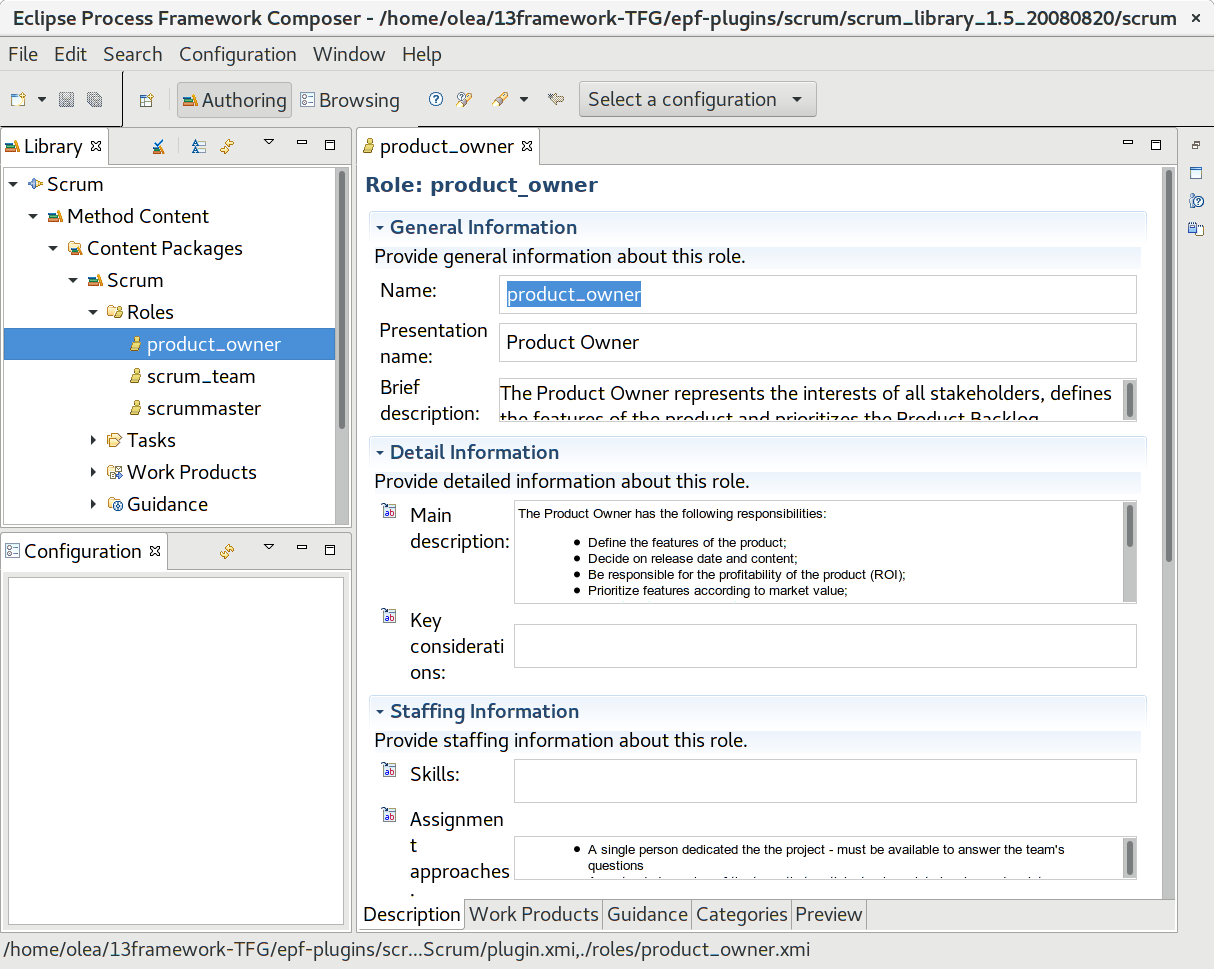
I had success running the Windows EPF version using Wine and I can do some work with it, but at some point the program gets inestable and needs to reboot. Other very interesting advantage of running native is I can use the GTK+ filechooser which is really lot better than the simpler native Java one.
I plan to practice a lot modeling with EPF Composer in the coming weeks. Hopefully I’ll share some new artifacts authored by me.
PD: added the required libXt dependency.
How to cite bibliography ISO/IEC standards
For my final post-grade work I’m collecting bibliography and as the main work is around ISO/IEC documents I investigated how to to make a correct bibliography entry for these, which I realized is not very well known as you can check in this question in Tex.StackSchange.com.
I finally chose an style I show here as an example:
- BibTeX:
@techreport{iso_central_secretary_systems_2016, address = {Geneva, CH}, type = {Standard}, title = {Systems and software engineering -- {Lifecycle} profiles for {Very} {Small} {Entities} ({VSEs}) -- {Part} 1: {Overview}}, shorttitle = {{ISO}/{IEC} {TR} 29110-1:2016}, url = {https://www.iso.org/standard/62711.html}, language = {en}, number = {ISO/IEC TR 29110-1:2016}, institution = {International Organization for Standardization}, author = {{ISO Central Secretary}}, year = {2016} } -
RIS:
  TY  - RPRT
  TI  - Systems and software engineering -- Lifecycle profiles for Very Small Entities (VSEs) -- Part 1: Overview
  AU  - ISO Central Secretary
  T2  - ISO/IEC 29110
  CY  - Geneva, CH
  PY  - 2016
  LA  - en
  M3  - Standard
  PB  - International Organization for Standardization
  SN  - ISO/IEC TR 29110-1:2016
  ST  - ISO/IEC TR 29110-1:2016
  UR  - https://www.iso.org/standard/62711.html
  ER  -
I’ve using this style extensively in a development website http://29110.olea.org/. You can compare details with the official info.
Both have been generated using Zotero.